
First Nations creativity takes centre stage
Awaken Murrup. Awaken the Spirit.
Welcome to Kindred People.
First Nations creativity takes centre stage
Awaken Murrup. Awaken the Spirit. Welcome to Kindred People.
We acknowledge and pay respects to the Traditional Custodians of the unceded land on which our festival takes place, the Boonwurrung peoples of the Kulin Nation. We extend that respect to the Elders and Ancestors of all First Nations Peoples of our global Indigenous community.
If you ask Gunditjmara man Tom Molyneux to describe Kindred People – the highly anticipated cultural, ceremonial and artistic event coming to Monash University in September – the normally voluble and chatty Head of First Nations Programming and Engagement for Monash University Performing Arts Centres (MPAC) becomes momentarily, happily tongue-tied.
Yes, he explains, it’s a showcase of Indigenous-led innovation. It’s a platform for cultural and artistic expression – from circus performance to theatre, to contemporary music and more. But what else, exactly – and specifically?
It’s a chance for reflection, answers Molyneux, as well as community engagement – in the form of a hybrid arts festival and knowledge symposium.
He Huia Kaimanawa is an extraordinary performance experience that responds to the resurfacing, reclaiming and honouring of te reo Māori/the Māori language. This work makes its Australian premiere at Kindred People.
He Huia Kaimanawa is an extraordinary performance experience that responds to the resurfacing, reclaiming and honouring of te reo Māori/the Māori language. This work makes its Australian premiere at Kindred People.
“Not that ‘symposium’ is a word we’re leaning into much,” says Molyneux, smiling. “We’re calling it kummargi yulendj gadhaba, which, loosely translated from the Boonwurrung language means ‘knowledge rising up together’ – and we think that’s the way we want this event to feel. It’s partly about honouring the Indigenous wisdom and creativity that’s come before, but also about generating new knowledge and that opportunity for exchange, where things happen because different people are in the room, sharing the knowledges of their ancestors.”
Practically, that means everything from lecture-style presentations to demonstrations and workshops. “Things that actually ask people to be participants – really encouraging that dialogue,” Molyneux says. “Some people might bring academic knowledge into the realm, others will bring cultural and community knowledge from their lived experience.”
Tom Molyneux, Head of First Nations Programming and Engagement for Monash University Performing Arts Centres (MPAC)
Tom Molyneux, Head of First Nations Programming and Engagement for Monash University Performing Arts Centres (MPAC)
Molyneux, who is also a Monash alumnus, joined the University in 2024 after working in a range of roles across higher education and the arts. He’s excited to see Indigenous peoples from all over the world bring their perspectives. “We’re looking for conversations that are deep and rich, whilst enjoying an array of incredible Indigenous-led artistic offerings that will stimulate further thought and deep listening.”
Drawing such disparate histories and experiences together in a contemporary setting is an exhilarating part of the overall purpose – this chance to look at old practices reframed within the reality of 2026 society.
UPU is an extraordinary performance of Pasifika poetry and storytelling, bringing together voices from across Te Moana Nui a Kiwa (the Pacific Ocean) in a bold, immersive theatrical experience. This work will make its Victorian premiere at Kindred People.
“That’s the Indigenous way, after all, where time is not always held out to be linear, but rather influences and reverberates across generations."
“It’s important that we’re realistic – that we are two and a half centuries into a colonised existence on this continent, and you can’t undo that, you can’t rewind that or pretend it hasn’t had an impact. But there’s an important reframing that can also occur.”
Two Blood 雙血 – Photo credit Jonathan VDK – Photo credit Jonathan VDK
Two Blood 雙血 – Photo credit Jonathan VDK – Photo credit Jonathan VDK
Kindred People concludes with Djeembana Yalinwa, a vibrant Community Day celebrating First Nations music, creativity and connection, with a free concert at the Clayton campus headlined by the exceptional duo Electric Fields (pictured).
Kindred People concludes with Djeembana Yalinwa, a vibrant Community Day celebrating First Nations music, creativity and connection, with a free concert at the Clayton campus headlined by the exceptional duo Electric Fields (pictured).
He Huia Kaimanawa is an extraordinary performance experience that responds to the resurfacing, reclaiming and honouring of te reo Māori/the Māori language. This work makes its Australian premiere at Kindred People.
He Huia Kaimanawa is an extraordinary performance experience that responds to the resurfacing, reclaiming and honouring of te reo Māori/the Māori language. This work makes its Australian premiere at Kindred People.
Blakademia is an intimate verbatim truth‑telling ceremony where student performers carry the lived experiences of First Nations scholars, inviting deep listening within university spaces.
Blakademia is an intimate verbatim truth‑telling ceremony where student performers carry the lived experiences of First Nations scholars, inviting deep listening within university spaces.
UPU brings the rich voices of Te Moana Nui a Kiwa (the Pacific Ocean) to life. Photo Credit: Andi Crown
UPU brings the rich voices of Te Moana Nui a Kiwa (the Pacific Ocean) to life. Photo Credit: Andi Crown
UPA, Sydney Opera House. Photo Credit: Daniel Boud
UPA, Sydney Opera House. Photo Credit: Daniel Boud
He Huia Kaimanawa
He Huia Kaimanawa
That’s the case in two elements of Kindred People in particular, including an intimate concert experience – Decolonising The Bells – led by Noongar composer Aaron Wyatt with Speak Percussion, as well as a brand new circus performance commissioned for the festival called The Scarecrow & Waa by Na Djinang Circus, which will premiere in the George Jenkins Theatre.
The Scarecrow & Waa
Na Djinang Circus
On the latter, circus is a relatively new performing arts medium, and Na Djinang is a young Indigenous-led company from Naarm who’ve taken the seed of an idea and experimented, pushing boundaries in a show that shares Kulin stories with both humour and dynamism.
“We’re working to discover, interrogate and push the form of blak circus, not only in stage practice but producing, strategy, the art form and storytelling,” says Harley Mann, the 28-year-old Wakka Wakka man and Artistic Custodian for the company. “You’re not crafting something out of nothing. The tensions of life, reality and story are all around us – we’re just the lightning rod. The artists are discovering this thing with each other right now – what it means, what it means to us, and why we want to tell this story.”
Mann has been in the circus his whole life, starting as an acrobat after school, but he’s no longer obsessed with the physical reps required to perform a show over and over, night after night. His role now is to build, imagine and dream about what kinds of shows they want to do.
Harley Mann, Founder of Na Djinang Circus
Harley Mann, Founder of Na Djinang Circus
“I like the challenges and problem-solving of creating work and pushing those ideas past their initial impetus into things that are a little more complicated, harder to answer, sticky, and confusing.”
Mann doesn’t usually love the idea of waiting for stories to emerge – that’s too passive and inactive for him – and yet one day a story simply crept into discussion, about two characters, who are unusual friends, both trying to look after this place we call home.
“One is the Kulin deity, Waa, a magic man, healer and protector who can travel through time and appears in the form of a crow,” Mann says, “set against the irony of the scarecrow – a protector of Country, from the protector of Country, an irony I found hysterical. There’s this unusual mirror in their existence. But I don’t want to give away any more!”
The opportunity has been more than gratifying. Art doesn’t exist without an investment – financial as well as cultural – in curiosity. That’s why Mann is thankful for what this kind of production means for his performers, in the pragmatic sense.
“Circus and blackfella culture are often pushed to the outskirts, their legitimacy questioned, which is present in the subtext through everything from funding streams to the stages available,” he says. “With The Scarecrow & Waa, they get paid for their work – this is their job, their career – and they get a level of satisfaction and professional pride, too.”
And what does he get from the experience? “A kind of excitement, and also a catharsis in making work and challenging yourself,” Mann says. “You’ve got to be open to the idea that your opinions are wrong, otherwise the work becomes a lecture, or a sermon. The potential for risk and failure is so high when you will something into existence – when you make something from nothing. It’s deathly scary, but as a result, it’s extraordinarily thrilling.”
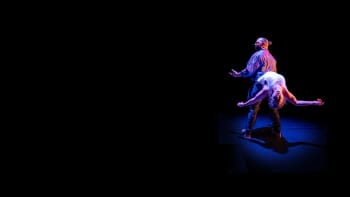
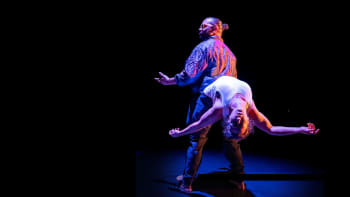
On the latter, circus is a relatively new performing arts medium, and Na Djinang is a young Indigenous-led company from Naarm who’ve taken the seed of an idea and experimented, pushing boundaries in a show that shares Kulin stories with both humour and dynamism.
“We’re working to discover, interrogate and push the form of blak circus, not only in stage practice but producing, strategy, the art form and storytelling,” says Harley Mann, the 28-year-old Wakka Wakka man and Artistic Custodian for the company. “You’re not crafting something out of nothing. The tensions of life, reality and story are all around us – we’re just the lightning rod. The artists are discovering this thing with each other right now – what it means, what it means to us, and why we want to tell this story.”
Mann has been in the circus his whole life, starting as an acrobat after school, but he’s no longer obsessed with the physical reps required to perform a show over and over, night after night. His role now is to build, imagine and dream about what kinds of shows they want to do.
Harley Mann, Founder of Na Djinang Circus
Harley Mann, Founder of Na Djinang Circus
“I like the challenges and problem-solving of creating work and pushing those ideas past their initial impetus into things that are a little more complicated, harder to answer, sticky, and confusing.”
Mann doesn’t usually love the idea of waiting for stories to emerge – that’s too passive and inactive for him – and yet one day a story simply crept into discussion, about two characters, who are unusual friends, both trying to look after this place we call home.
“One is the Kulin deity, Waa, a magic man, healer and protector who can travel through time and appears in the form of a crow,” Mann says, “set against the irony of the scarecrow – a protector of Country, from the protector of Country, an irony I found hysterical. There’s this unusual mirror in their existence. But I don’t want to give away any more!”
The opportunity has been more than gratifying. Art doesn’t exist without an investment – financial as well as cultural – in curiosity. That’s why Mann is thankful for what this kind of production means for his performers, in the pragmatic sense.
“Circus and blackfella culture are often pushed to the outskirts, their legitimacy questioned, which is present in the subtext through everything from funding streams to the stages available,” he says. “With The Scarecrow & Waa, they get paid for their work – this is their job, their career – and they get a level of satisfaction and professional pride, too.”
And what does he get from the experience? “A kind of excitement, and also a catharsis in making work and challenging yourself,” Mann says. “You’ve got to be open to the idea that your opinions are wrong, otherwise the work becomes a lecture, or a sermon. The potential for risk and failure is so high when you will something into existence – when you make something from nothing. It’s deathly scary, but as a result, it’s extraordinarily thrilling.”
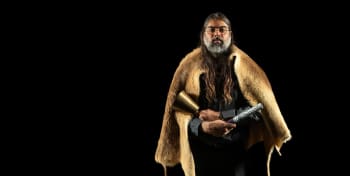
Decolonising the Bells, meanwhile, brings an entirely different tenor to the event. Helmed by Noongar man Aaron Wyatt, the Helpmann-nominated conductor and viola player – and also a researcher and assistant lecturer in the Sir Zelman Cowen School of Music and Performance at Monash University – the work centres around the federation handbells. A gift marking the centenary of Federation, they are, therefore, artifacts with a complicated legacy.
The 40-minute performance utilises these bells, along with an electronic track, not to mention a lonely viola performance by Wyatt himself, in a piece that picks up where another recent Speak Percussion project, Bell Curve, left off. Wyatt, who is not merely an ensemble expert but an innovator, can’t wait for the world premiere in the David Li Sound Gallery, featuring its Meyer Constellation active acoustic system – a full 360 degree wraparound experience in which the audio can be manipulated in interesting ways.
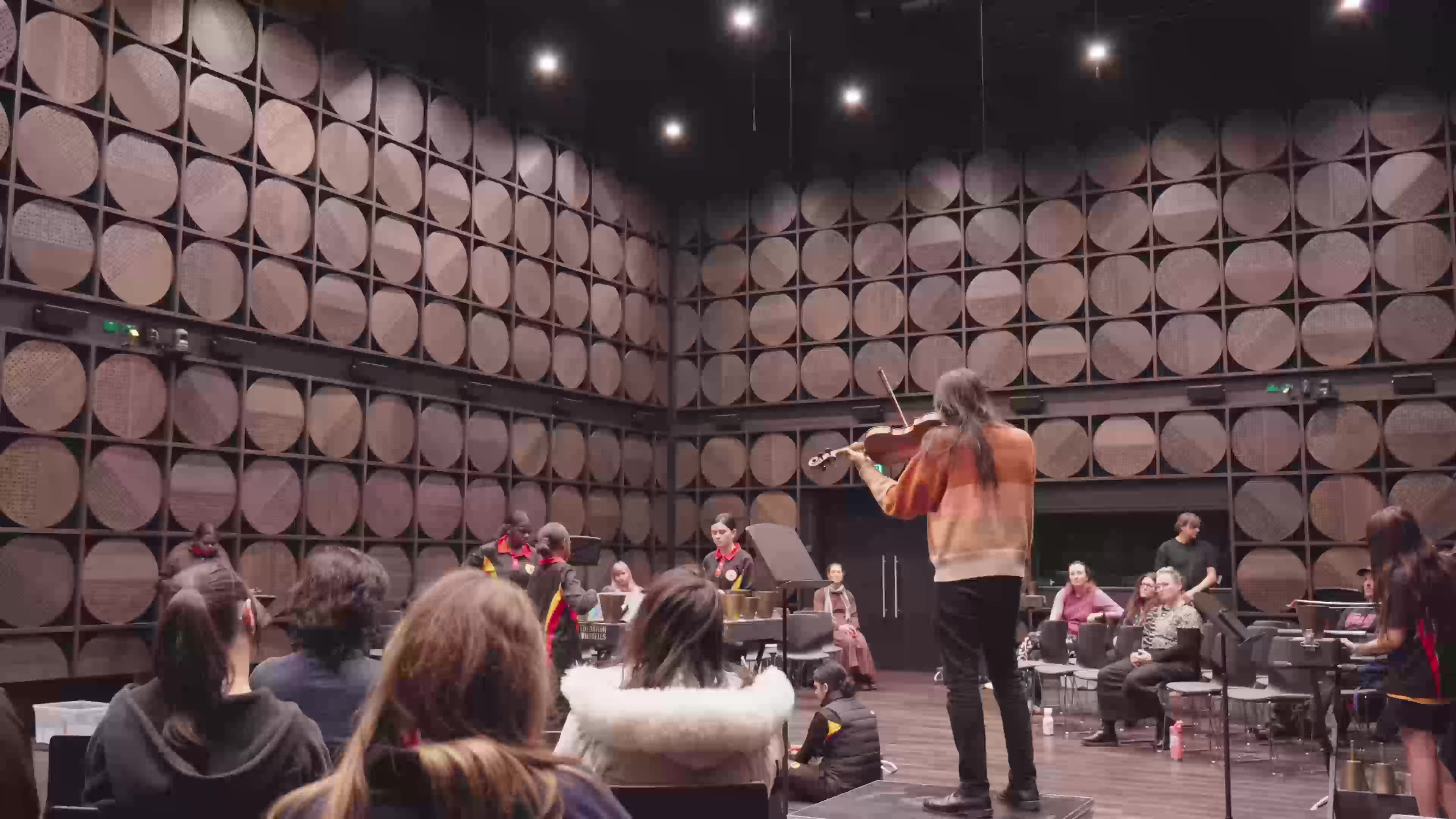
The result is bound to be compelling, given his own virtuosic talent, married with the cutting edge technological presentation, and a vital community-minded aspect of this production. The bell ringers, after all, are cut from diverse cloth. Six of the 12 players will be a mix of students from the William Cooper Institute, and Monash University’s Sir Zelman Cowen School of Music and Performance, with priority given to those who’ve done an on-Country unit. The other six will be high school students from Worowa Aboriginal College in Healesville, who are being taught right now how to chime, strike and stroke the bells to varied effect.
“It’s not about people’s musical ability, but a participatory experience,” Wyatt says. “It’ll have that democratic element.”
It’s a radical aural experiment, in many ways, standing in stark contrast to the tradition and history of the bells themselves. Wyatt notes that the piece is informed by research looking into how bells were used in the early colony, from notifying citizens about specific events, to acting as a kind of indicative structure for the day.
What will it look like on stage?
Four players in the middle of the space, on a carpet square, facing each other, each surrounded by an array of bells. The audience sits around them, and they are in turn surrounded by eight more players, meaning each listener will get a unique impression of the sound of players striking the bells, or bowing them, or hitting them with a mallet before submerging them in water, producing a glissando effect.
(Click unmute icon to hear sound)
(Click unmute icon to hear sound)
Sounds will come from nowhere, then rapidly cut. Others will grow slowly and be stretched to their limit. Combine that with the electronics, and Wyatt’s viola, and the calibration of 64 speakers in the wall and ceiling of the state of the art theatre, and the result should be mesmerising.
“The sound will be overhead and all around, moving imperceptibly or surprisingly, washing over you.”
“It goes through these phases. Deconstruction first, then contemplation – meditative and subtle – and then this reforging, which is loud and empowering and sonically exciting, with tempos coming together. There are moments that are quite haunting, exciting, and emotional.”
Knowing all this, it’s easy to wonder what excites Tom Molyneux and the Kindred People steering committee most. The answer for Molyneux is not simply the performances, spectacular though they will be, but rather the commitment from the university to a bold, new idea – the sense of support from Vice-Chancellor Professor Sharon Pickering and Deputy Vice-Chancellor (Indigenous) and Senior Vice-President Professor Tristan Kennedy all the way down and through the institution. Support that provides tangible opportunities for new and established First Nations artistic voices, alongside local and international knowledge-holders, to share their incredible talents and ancestral wisdom with the world.
“All these people are making sure that, as a university, we’re walking the walk and not just talking the talk,” says Molyneux. “I’m pleased to be a small cog in a really large wheel, and part of this generous invitation to communities, to participate and celebrate, and, in a complicated world, to come together.”
About
Kindred People is an Indigenous‑led gathering of global First Nations artists, Elders, Knowledge Holders, students and community, coming to Monash University on Boonwurrung Country. Guided by culture, the festival centres Indigenous knowledges, creativity and connection through ceremony, performance, dialogue and time spent together on Country.
Join us across Monash campuses from 1–5 September 2026.
Tickets are on sale now.
Thank you
A heartfelt thanks to the generous donors who support Kindred People:
The Vizard Foundation
Jane and Stephen Hains
The visual identity of Kindred People was created in collaboration with Gumbaynggirr artist, activist and creative Aretha Brown.
Indigenous Graduate Program
Yurranga Barring Duliin is Monash University’s 12-month Indigenous Graduate Program, designed to help Aboriginal and Torres Strait Islander people launch their careers with confidence.
Applications are welcomed from people with diverse experiences and pathways, including those who have developed valuable skills and capabilities through professional work, community leadership, or other experiences outside formal study.
Indigenous Alumni Network
The new Indigenous Alumni Network, Djambana Ballert Gadhaba, is led by the William Cooper Institute. In the spirit of our name — Djambana Ballert Gadhaba, meaning “the community is strong together” — this network is built on connection, belonging, and shared strength.
It provides a culturally respectful and meaningful space for alumni to stay connected with each other and the broader Monash community.
More from Monash Life
Explore more stories of impact, discovery and innovation
in Monash Life.